
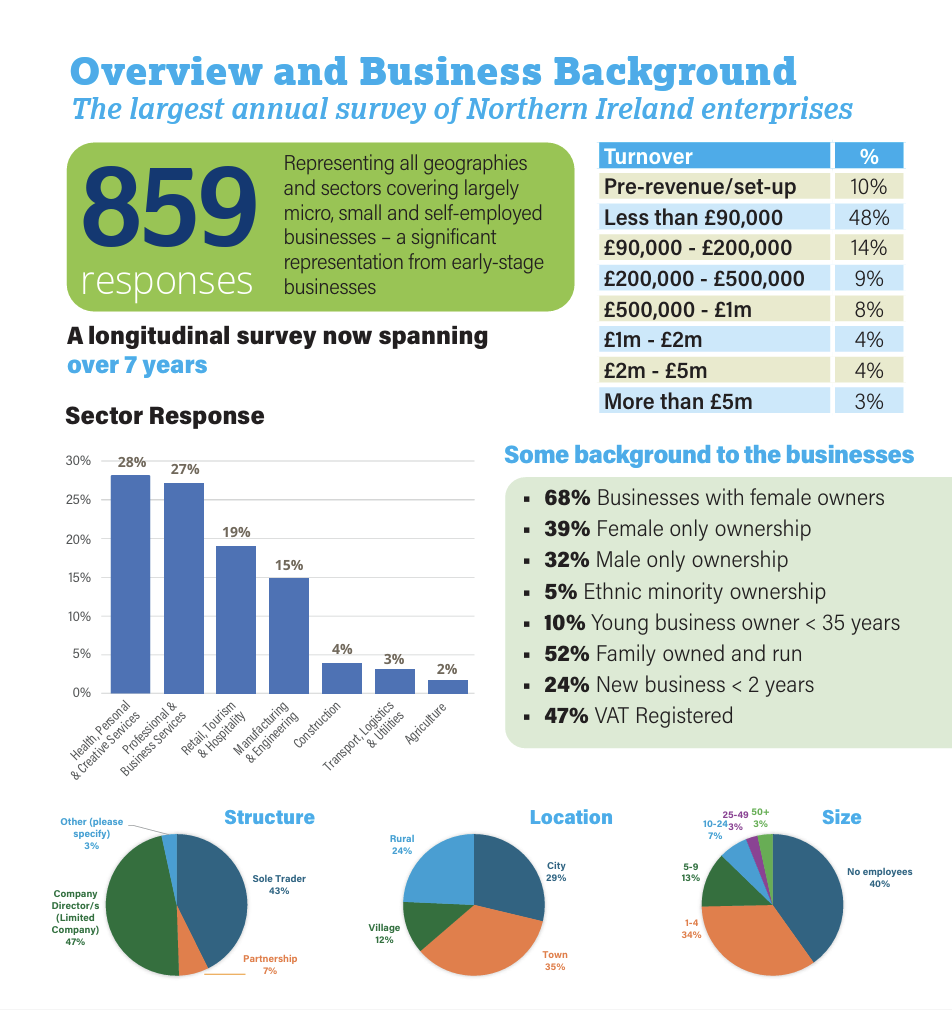
The 2025 NI Enterprise Barometer gives one of the clearest pictures of how small and medium sized businesses in Northern Ireland are really performing. It draws on responses from 859 enterprises, largely micro, small and self-employed businesses, and tracks performance over seven years.
As a commercial finance broker working with SMEs across Northern Ireland, I recognise many of the themes in this report from everyday conversations with clients. Rising costs, pressure on cash flow, ongoing demand for finance and uncertainty about the future are all present. At the same time, there is resilience and a clear appetite for growth.
In this article I want to highlight the main findings from the Barometer and reflect on what they may mean for your financial planning and funding strategy. This is general information, not personal advice, but I hope it helps you assess where your business stands and what questions you might need to ask next.
A Mixed Performance Picture With Cautious Optimism
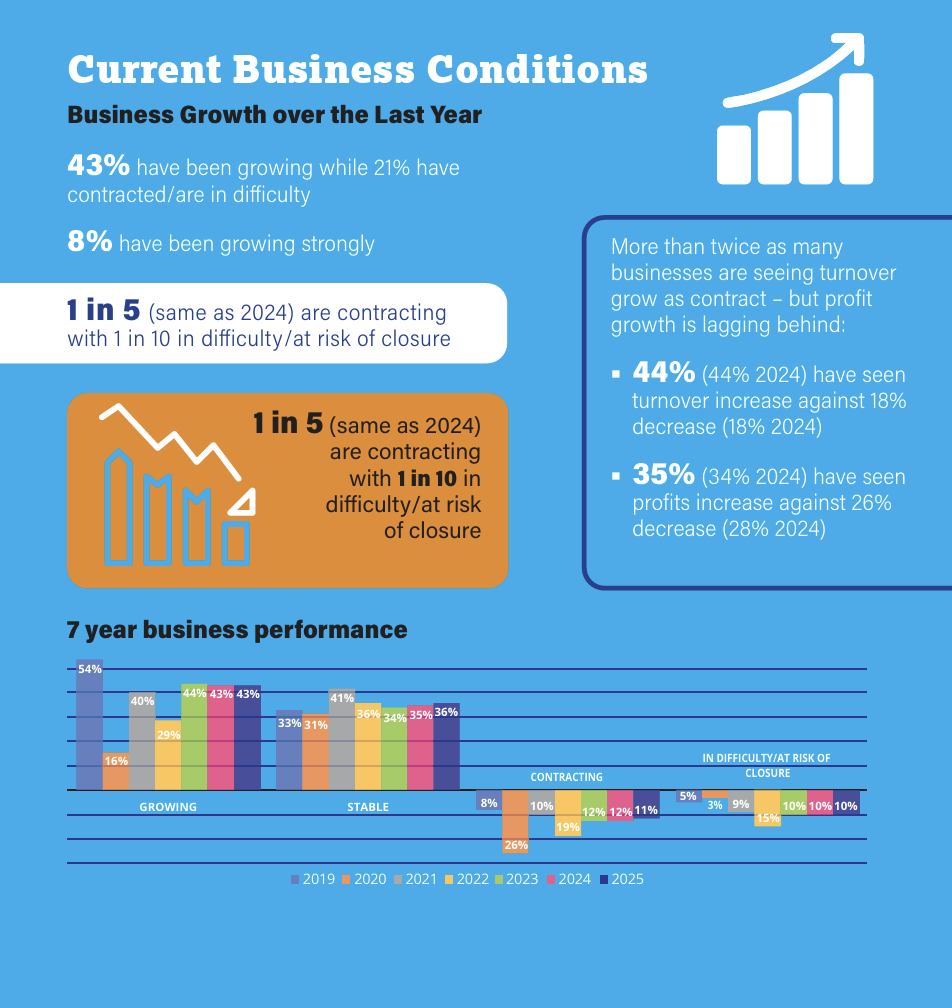
The Barometer shows a business base that is still active and ambitious, but also under strain. Over the last year, 43 per cent of businesses report that they have been growing, while 21 per cent say they have contracted or are in difficulty. Around one in five businesses (21 per cent) report negative performance – comprising 11 per cent who are contracting and 10 per cent who are in difficulty or at risk of closure.
Turnover performance is stronger than profit performance. Forty-four per cent of firms have seen turnover increase, compared with 18 per cent seeing a decrease. Profits, however, tell a more balanced story, with 35 per cent reporting an increase and 26 per cent a decrease.
Looking ahead, 56 per cent of businesses expect to grow in the next year, compared with 43 per cent that actually grew this year. Fourteen per cent expect trading conditions to be difficult.
What this means for finance and planning
For growing businesses, these figures reinforce the need to plan finance ahead of demand. If turnover is increasing but profit margins are tight, then working capital and cash flow facilities become more important. Businesses that expect growth should consider whether existing overdrafts, invoice finance, or revolving facilities are still suitable for higher levels of activity.
For those contracting or at risk, the priority is often stability. That may mean reviewing existing borrowing, checking covenant positions, and assessing whether repayment schedules are realistic under current trading conditions. Early engagement with lenders or a broker can help avoid problems later, particularly where profitability has weakened even as sales volume has held up.
Cost Pressures Are Embedded And Affecting Cash Flow
The report confirms that the cost of doing business remains the dominant issue. Costs have increased in the last twelve months for almost 78 per cent of businesses, with many reporting double-digit increases.
Utilities, raw materials and insurance are the three most significant rising costs, each affecting over 80 per cent of firms. Half of businesses report raw material costs rising by more than 10 per cent, which is the steepest jump of any category. Wage costs are also increasing, with 72 per cent of businesses reporting higher wage bills, one third seeing increases of more than 10 per cent, and 10 per cent experiencing rises above 30 per cent.
Compliance costs are rising for 70 per cent of firms. Borrowing and financing costs have increased for 57 per cent, and property costs are up for 61 per cent.
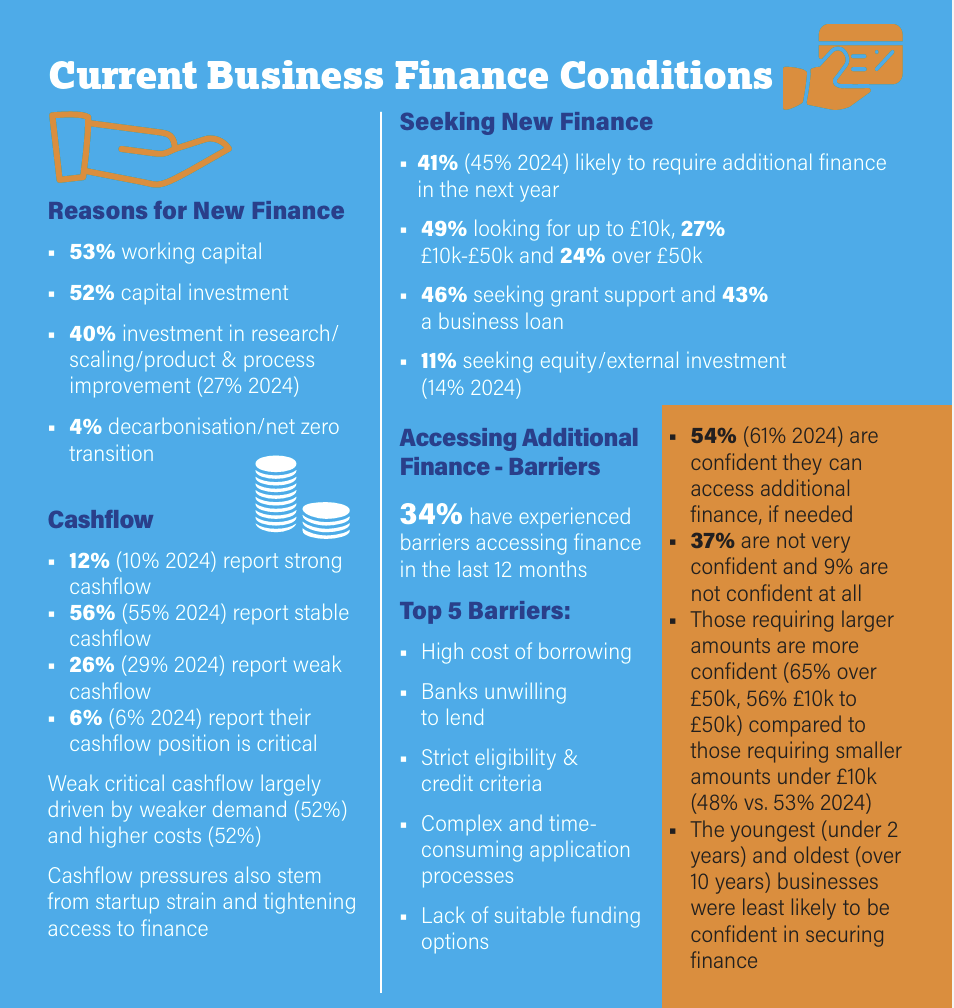
It is not surprising, therefore, that one in three businesses describe their cash flow position as weak or critical. Only 12 per cent report strong cash flow, 56 per cent say it is stable, 26 per cent say it is weak and 6 per cent say it is critical. Weak or critical cash flow is largely driven by weaker demand and higher costs, each cited by 52 per cent of affected businesses, as well as startup strain and tightening access to finance.
What this means for finance and planning
When fixed and variable costs increase faster than revenue, the impact is felt most immediately in cash flow. For many businesses, the challenge is not simply finding more sales, but ensuring there is enough working capital to cover wages, suppliers, tax and existing finance commitments.
Practical steps can include:
- Reforecasting cash flow under realistic scenarios that reflect current input costs.
- Reviewing whether existing overdraft limits, invoice finance lines or other working capital facilities still provide enough headroom.
- Considering whether asset finance or refinancing of existing obligations could help to spread costs in a more manageable way.
For clients I work with in manufacturing, transport, retail and agriculture, these discussions often focus on matching finance structures to real trading cycles. For example, seasonal businesses may need facilities that reflect peaks and troughs, while capital intensive firms may benefit from longer-term asset finance to support essential equipment.
Significant Ongoing Demand For Finance And Clear Barriers
Against this backdrop, it is understandable that many businesses expect to need additional finance. Forty-one per cent of respondents say they are likely to require extra finance in the next year. This is slightly lower than 2024, when 45 per cent expected to need it, but still represents a significant share of the SME base.
Of those expecting to seek finance, 49 per cent are looking for up to £10,000, 27 per cent for £10,000 to £50,000, and 24 per cent for more than £50,000. Grants are the most frequently mentioned source, with 46 per cent seeking grant support, followed by 43 per cent planning to apply for a business loan. Eleven per cent are seeking equity or external investment, down from 14 per cent in 2024.
The main reasons for seeking new finance are working capital (53 per cent) and capital investment (52 per cent). Notably, 40 per cent are specifically targeting growth-focused activities, including scaling, research, and product development (up from 27 per cent in 2024).
However, 34 per cent of businesses have experienced barriers when trying to access finance in the past twelve months. The top barriers are high cost of borrowing, banks being unwilling to lend, strict eligibility and credit criteria, complex and time consuming application processes, and a lack of suitable funding options.
Despite this, 54 per cent say they are confident that they could access additional finance if required, though confidence is lower among the youngest firms (under two years old) and the oldest (over ten years). Those seeking larger amounts tend to be more confident than those seeking under £10,000.
What this means for finance and planning
If you expect to need additional finance in the next year, the Barometer findings suggest three practical priorities.
First, clarity of purpose. Lenders, whether banks or alternative funders, want to see a clear case for why the finance is needed and how it will be repaid. The report shows that working capital and capital investment are the main drivers, so explanations that link funding to specific costs, projects or efficiency improvements are important.
Second, preparation. Many of the barriers reported by businesses relate to application processes, eligibility and documentation. Up to date management accounts, realistic projections and a clear understanding of your existing commitments can all help to reduce friction.
Third, awareness of options. The report highlights a perceived lack of suitable funding choices. In practice, there is a wide range of products available, from secured and unsecured loans to asset finance, invoice finance and other specialist facilities. As an independent broker, my role is to help businesses compare those options and align them with their circumstances and sector.
People, Skills And The Financial Impact Of Capacity Constraints
Finance is only one part of the picture. The Barometer shows that many businesses are constrained by people and skills issues. Eighteen per cent of all respondents report persistent or hard to fill vacancies, and among those employing staff, this rises to 27 per cent. Of the businesses with persistent vacancies, 68 per cent say this is putting the business under operational strain, 67 per cent say it is limiting growth, and 43 per cent say it is negatively affecting productivity and efficiency.
More than half of businesses, 54 per cent, find it difficult to secure the right skills. Forty-four per cent would consider taking on an apprentice, but many say they are unable to do so because of criteria around business suitability and scale, lack of capacity, or financial constraints.
When it comes to skills development, the top five gaps are marketing and communications (47 per cent), sales, exporting and business development (31 per cent), embracing new technologies (26 per cent), understanding and embracing Artificial Intelligence (24 per cent), and market or customer research (24 per cent). One in four businesses now identify skills development needs in AI and new technologies, which signals a growing need for digital capability building.
At the same time, 42 per cent of businesses do not know where or how to access the right skills support.
What this means for finance and planning
Capacity and skills issues have a direct bearing on financial planning. If vacancies cannot be filled, or if key functions such as sales and marketing are under-resourced, then growth forecasts may not be realistic. This matters because lenders will often test assumptions about turnover and margin when assessing applications.
Businesses may also need to consider investing in technology, equipment or training to maintain productivity in the absence of additional staff. That in turn may require capital expenditure and therefore finance. For example, manufacturers might explore asset finance for improved machinery, while professional services firms may look at technology upgrades to support efficiency.
The key is to be honest about capacity constraints and to reflect them in your financial planning rather than assuming they will resolve themselves. Where investment is needed to address skills or productivity issues, early planning of finance can help spread the cost and reduce pressure on cash flow.
Trading Conditions, EU Exit And External Pressures
The Barometer also looks at trading conditions beyond Northern Ireland. Forty-eight per cent of businesses plan to make sales outside Northern Ireland in the next twelve months.
However, external factors continue to create challenges. Thirty-seven per cent of businesses say that the UK’s exit from the EU has negatively impacted them. Twenty-five per cent say the Windsor Framework has had a negative impact, and 17 per cent say US tariff announcements have affected them. Businesses report higher costs, increased paperwork and supply difficulties when trading with Great Britain or international markets, with many saying these challenges have worsened since Brexit.
Some respondents describe tourism impacts from new travel authorisation requirements and difficulties with delivery to Northern Ireland from Great Britain.
What this means for finance and planning
For businesses exposed to cross border or international trade, these findings underline the importance of resilience in working capital planning. Longer lead times, customs requirements, delivery issues and exchange rate movements can all affect when cash comes in and what it costs to fulfil orders.
In practice, this may mean:
- Allowing for longer debtor days or higher stock levels in cash flow forecasts.
- Considering whether trade-related facilities, such as invoice finance or specific working capital lines, could help bridge gaps between shipping, invoicing and payment.
- Building contingency into finance structures so that temporary disruptions do not immediately create liquidity stress.
The right solution will vary by sector and business model. For example, manufacturers supplying GB or EU markets may need to finance raw materials and production for longer periods, while service businesses working internationally may face different timing pressures. The common thread is the need to match finance to real trading conditions rather than assuming a return to previous patterns.
What Businesses Want From Support And Where Finance Fits In
One of the most useful parts of the Barometer is the section on business support. It confirms that Northern Ireland businesses want practical, personalised help that is easy to access and directly relevant to their needs.
Face to face mentoring remains the most valued form of support, mentioned by 57 per cent of respondents, followed by networking and collaboration with other businesses (37 per cent) and access to digital resources and support opportunities (36 per cent). Subject specific masterclasses, tailored digital notifications and business information websites are also valued, but to a lesser extent.
When asked to identify the single most important area of support they need right now, businesses highlight sales, business development and exporting (20 per cent), digital marketing and social media trends (19 per cent), financing and how to manage and access funding (16 per cent), new technologies including AI (11 per cent), and people related support such as hiring and managing teams (8 per cent).
The report also summarises the top initiatives that businesses would like the NI Executive and the enterprise support ecosystem to introduce. These include cutting the cost burden, making funding more accessible through simpler grants and loans, creating a single hybrid support hub, strengthening workforce and apprenticeship support, and improving the overall business environment, including energy costs and premises.
What this means for finance and planning
For me, one of the clearest messages here is that many business owners want straightforward guidance on finance. Sixteen per cent identify financing as their number one support need, and many others point to complexity and lack of information as barriers.
In my work at Johnston Financial Solutions, I see the value of combining finance knowledge with local understanding. Our role as an independent credit broker is to help businesses across sectors such as manufacturing, transport, retail, agriculture and professional services understand their options and structure finance that supports their goals.
That often means:
- Translating lender criteria into plain language.
- Helping clients prepare realistic forecasts and documentation.
- Comparing products such as commercial property finance, asset finance and unsecured lending.
- Supporting longer term planning, for example where businesses want to invest steadily in equipment rather than in one step.
The Barometer reinforces that there is demand for this kind of support, particularly where finance is concerned.
Practical Next Steps For Business Owners
The Enterprise Barometer paints a picture of a resilient but pressured SME base in Northern Ireland. Costs are higher, cash flow is tighter and access to finance can be challenging, yet many businesses still plan to grow and are looking for ways to invest in improvement.
In that context, my practical suggestions are:
- Take an honest look at your cash flow position, using up to date figures that reflect current costs and realistic sales assumptions.
- If you expect to need additional finance, start planning now rather than waiting until the need is urgent. Preparation can reduce the impact of the barriers highlighted in the Barometer.
- Review whether your current finance structure is still appropriate. For some firms, there may be scope to move short term borrowing into structured facilities, or to use asset finance for equipment rather than relying solely on overdrafts.
- If skills, capacity or technology are limiting your growth, consider whether targeted investment in equipment or systems could improve productivity. In many sectors, finance can play a role in enabling these investments without putting unsustainable pressure on reserves.
Every business is different, and any finance decision should be taken with full regard to your own circumstances, risk tolerance and professional advice.
At Johnston Financial Solutions, we work with a broad panel of lenders, from mainstream banks to alternative funders, to help clients find suitable options for commercial property, asset finance and unsecured lending. We also offer business planning and financial forecasting support to help you approach funding with clarity and confidence.
If the findings of the 2025 NI Enterprise Barometer resonate with your own experience, now may be a good time to review your funding structure and explore whether it is still fit for purpose in the current environment.
Read the barometer here >> enterpriseni.com/the-voice-of-business/ni-enterprise-barometer-2025
This article is for information purposes only and should not be treated as tax advice or a substitute for professional tax planning.
Johnston Financial Solutions is an independent credit broker and is not a lender. We may receive commissions from lenders where we introduce business.
Johnston Financial Solutions is authorised and regulated by the Financial Conduct Authority. Commercial finance is subject to status and lending criteria